

For most equipment buyers planning regular, long-term operation, LED light towers offer better overall value than metal halide light towers. LED technology generally provides longer lamp life, lower maintenance requirements, and more efficient energy use. Metal halide light towers can still be suitable for projects with existing metal halide equipment, specific lighting requirements, or limited operating hours. The best investment depends on total operating cost, required illumination, maintenance frequency, and project duration—not simply the initial purchase price.
When comparing LED vs. metal halide light towers, construction companies, rental businesses, mining operators, and infrastructure contractors should evaluate the complete lighting system. Lamp wattage alone does not determine real-world performance. Buyers should also consider luminous output, illumination coverage, color temperature, lamp service life, generator fuel consumption, and replacement costs.
ONEWPOWER, a manufacturer of generator sets and mobile light tower equipment, offers LED light tower configurations as well as metal halide options. Its published models provide practical examples for comparing the two technologies under commercial operating conditions.
LED and metal halide lamps generate light through different technologies. LED lamps use semiconductor components to produce illumination, while metal halide lamps generate light through an electric arc inside a gas-filled bulb.
For equipment buyers, the difference becomes important during daily operation. LED systems are generally valued for their energy efficiency, long service life, and ability to provide consistent illumination with relatively low maintenance. Metal halide systems have been widely used in industrial and outdoor lighting applications for years, and some buyers may already have experience, replacement parts, or maintenance procedures for this technology.
Neither technology should be judged by wattage alone. A lower-wattage LED configuration may deliver substantial luminous output, while the actual performance of either system depends on lamp efficiency, beam distribution, mounting height, and site conditions.
| Evaluation factor | LED light tower | Metal halide light tower |
|---|---|---|
| Energy efficiency | Generally higher light output per watt | Generally lower than modern LED systems |
| Lamp service life | Often longer, depending on design and operating conditions | Generally shorter and more replacement-sensitive |
| Maintenance | Typically less frequent lamp replacement | More attention to lamp and ballast components |
| Light performance | Directional lighting and flexible optical designs | Established high-intensity lighting technology |
| Long-term value | Often favorable for frequent operation | Depends on purchase cost and operating hours |
These are general technology characteristics, not guaranteed specifications for every product. Actual performance should be confirmed using the manufacturer's lamp data and the complete light tower configuration.
The main advantage of LED lighting is its combination of efficient light production and long service life. For equipment that operates through repeated night shifts, fewer lamp replacements can reduce maintenance labor, spare-parts inventory, and interruptions to site operations.
Consider ONEWPOWER's ON1200E mobile light tower generator. Its published specifications include four 350W LED lamps, a luminous efficiency of 150 lm/W, a 5000K color temperature, and IP67 protection for the lamp protection glass. The listed lamp service life is 50,000 hours. The unit also features a vertical hydraulic mast and a 100-liter fuel tank, with a stated operating time of up to 81 hours.
These specifications give buyers several useful reference points: lighting efficiency, color temperature, protection, service life, and operating duration. They should be assessed together rather than treating lamp wattage as the only selection criterion.
For contractors seeking a mobile LED solution for construction or industrial applications, the ONEWPOWER ON1200E mobile light tower generator provides a concrete example of a four-lamp LED configuration.
Another example is the ON2400 heavy-duty mobile light tower. ONEWPOWER lists four 600W LED lamps, a luminous output of 360,000 lumens, and an illumination area exceeding 3,000 m². Its published specifications also include a hydraulic mast, a maximum mast height of 8 meters, and a listed lamp life of 50,000 hours.
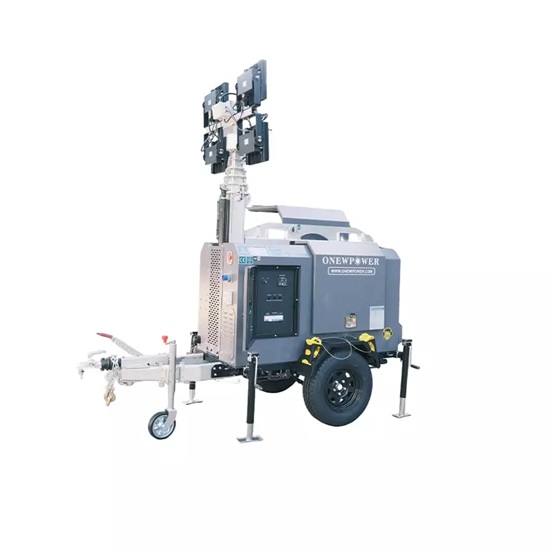
For larger work areas that require substantial lighting output, buyers can review the ONEWPOWER ON2400 heavy-duty mobile light tower and assess whether its lighting configuration matches the project's required illumination levels.
LED is not automatically the right answer for every buyer. Metal halide light towers may remain a reasonable choice when a company already operates compatible equipment, has established maintenance procedures, or needs to integrate a new unit into an existing fleet.
Initial purchase price can also influence decisions, particularly for projects with limited operating hours. However, buyers should compare the actual lamp replacement schedule, energy demand, ballast maintenance, and expected operating hours before deciding that a lower purchase price represents a better investment.
ONEWPOWER lists a 6kW–8kW light tower configuration under model 132C with metal halide lamps. The product page identifies a rated net output of 8.4/9.5, a three-cylinder water-cooled engine, and a stated lighting coverage of approximately 4,000 m² at an average of 20 lux. The listed mast options include laydown or vertical manual configurations.
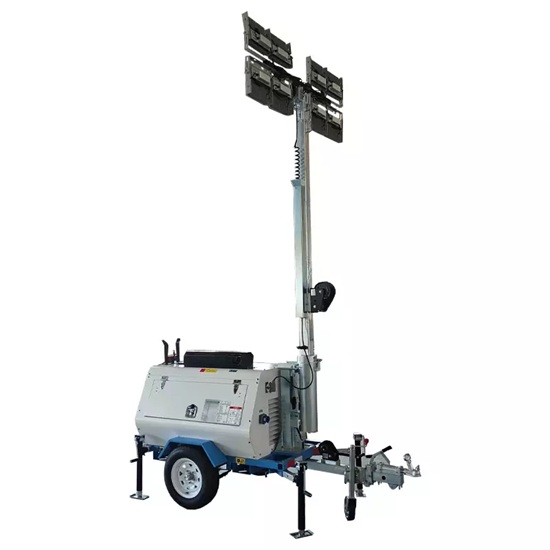
This provides a useful reference for buyers evaluating metal halide equipment for larger outdoor work areas. The precise lamp configuration and complete technical data should be confirmed with ONEWPOWER before ordering. See the ONEWPOWER 132C metal halide light tower configuration for the published product details.
The important point is to compare the actual equipment configuration. A metal halide model should not be assumed to have the same lamp life, power demand, or maintenance profile as an LED model simply because both are mounted on mobile generator towers.
For professional equipment buyers, total cost of ownership (TCO) is a more useful comparison than purchase price alone. A practical calculation should include:
TCO = Purchase Cost + Energy Cost + Maintenance Cost + Replacement Cost + Downtime Cost − Residual Value
For diesel-powered light towers, energy cost should include generator fuel consumption over the expected operating period. Buyers should request comparable fuel-consumption data for the complete equipment configuration rather than assuming that lower lamp wattage automatically produces a specific percentage of diesel savings.
To make the comparison concrete, consider a rental operator running a light tower 10 hours per day, 250 days per year (2,500 operating hours), with diesel at USD 1.20 per liter. At the same required illumination level, an LED tower such as the ON1200E draws less electrical power from the generator than a comparable metal halide configuration, so the generator runs at a lower load and burns less fuel per operating hour. Using the manufacturer's published fuel-consumption figures for each configuration, the annual fuel cost difference alone can reach several thousand US dollars. Over a five-year ownership period, add the reduced lamp replacement count (50,000-hour LED life versus a much shorter metal halide lamp interval), the reduced maintenance labor, and the lower spare-parts inventory, and the TCO gap widens further.
The exact figures depend on generator loading, engine efficiency, local fuel prices, maintenance intervals, and the actual number of operating hours, so buyers should substitute their own site data. The point is not the specific number but the method: compare both technologies over the same service period, at the same required illumination level, and under the same operating schedule.
For construction contractors, infrastructure projects, mining operations, and rental fleets with frequent operating hours, LED light towers are generally the stronger long-term option. Metal halide towers may still suit buyers with existing equipment fleets, specific project requirements, or shorter operating schedules. The following table summarizes the common decision scenarios.
| Buying scenario | Recommended technology | Primary reason |
|---|---|---|
| Frequent night operation, long-term ownership, rental fleet | LED | Long lamp life, fewer replacements, lower energy cost per operating hour |
| Existing metal halide fleet with compatible spare parts and procedures | Metal halide | Faster integration, spare-parts compatibility, familiar maintenance |
| Short project with limited operating hours | Metal halide | Lower upfront cost may outweigh runtime savings |
| Large work area requiring high output | High-output LED (e.g. ON2400) | Higher lumens per watt, wider coverage per fixture |
| High fuel cost or unstable fuel supply on site | LED | Lower generator load, reduced fuel consumption per hour |
Before making a purchase, confirm the required illumination area, average lux level, lamp output, mast height, operating hours, fuel consumption, and maintenance requirements. ONEWPOWER provides different light tower generator solutions for construction, mining, infrastructure, and other outdoor applications. Comparing the published specifications with your actual site requirements is the most reliable way to select a cost-effective unit.
For most long-term commercial applications, LED light towers offer better overall value because they generally provide higher energy efficiency, longer lamp life, and fewer lamp replacements. The best choice still depends on operating hours, lighting requirements, and total equipment cost.
Service life varies by product and operating conditions. ONEWPOWER lists a 50,000-hour lamp service life for both its ON1200E and ON2400 LED light tower configurations.
LED lamps generally require less electrical power for comparable lighting output, which may reduce generator loading. Actual diesel savings depend on the engine, generator efficiency, operating conditions, and complete lighting configuration.
They may be suitable for buyers with existing metal halide fleets, compatible spare parts, specific lighting requirements, or limited operating hours. A total cost comparison should include energy, lamp replacements, and maintenance.
Wattage measures electrical power consumption, while lumens measure the total visible light output. Buyers should compare lumens, beam distribution, and site illumination requirements rather than choosing a tower based only on lamp wattage.
The ON2400 is one option to evaluate. Its published configuration includes four 600W LED lamps, 360,000 lumens, and an illumination area exceeding 3,000 m². Actual site performance depends on layout, mast height, and lighting conditions.
Provide the required illumination area, target lux level, operating hours, preferred lamp technology, mast height, power requirements, project location, and expected quantity. This helps the manufacturer recommend a suitable configuration.
 NO.107 XIYUAN ROAD ,JINAN District,FUZHOU CITY, FUJIAN,CHINA
 E-mail: jina@onewpower.com


Mantente conectado
 |
Mapa del sitio
|
Xml
|
blog
|
política de privacidad
 Español

